Sessions Opens Hearing on Updates to DoD’s Struggling Background Check System
WASHINGTON—Subcommittee on Government Operations Chairman Pete Sessions (R-Texas) delivered opening remarks at today’s hearing on “An Update on DoD’s Struggling Background Check System.” In his opening statement, Subcommittee Chairman Sessions highlighted the ongoing issues delaying the Department of Defense’s (DoD) implementation of the National Background Investigation Services (NBIS) and expressed concern that the Defense Counterintelligence and Security Agency (DCSA) still does not have a director. The Subcommittee will continue oversight to ensure NBIS is fully implemented and effective.
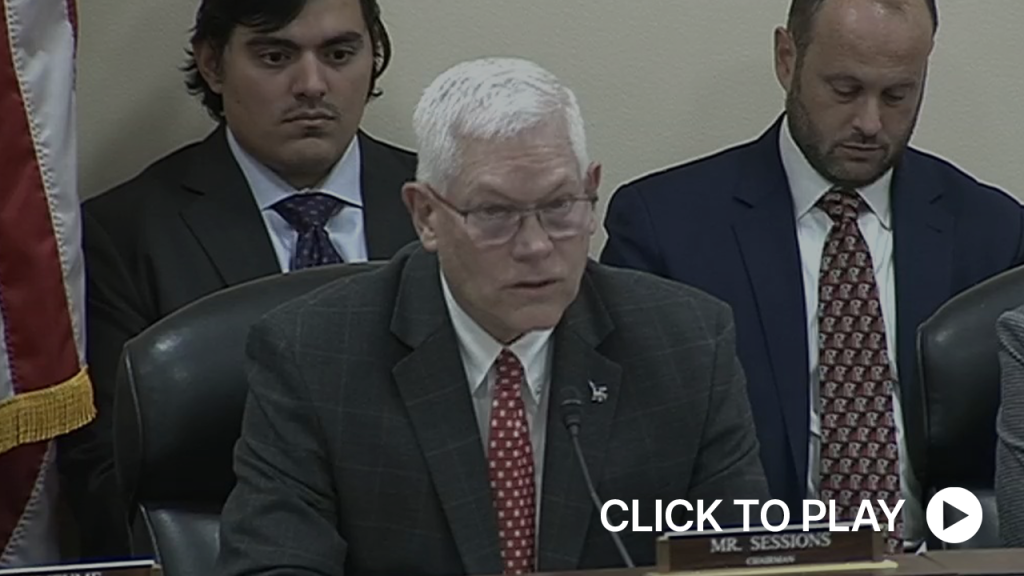
Below are Subcommittee Chairman Sessions remarks as prepared:
Welcome to today’s hearing on the modernization of the federal government’s background investigations and security clearance process—in particular, the Department of Defense’s National Background Investigation Services system, also known as NBIS.
If the topic of today’s discussion sounds familiar, it should. This Subcommittee first examined these issues in June of 2024, when we raised serious concerns about persistent failures in personnel vetting.
Unfortunately, the need for continued oversight has only grown more urgent.
During our initial hearing, we heard from Ms. Czyz, the same GAO witness we will hear from today.
GAO has been tracking problems with our nation’s federal personnel vetting processes since as far back as 2005.
We also heard from then-DCSA Director David Cattler, who was brand new to the job at the time, about the program’s significant management and oversight shortcomings, poor schedule and cost planning, and dozens of cybersecurity risks.
At the time, our witnesses offered recommendations and commitments to corrective action.
Today, our focus remains squarely on NBIS and whether the program is on track to support the administration’s stated goal of accelerating background investigations and security clearances.
Specifically, we want to know whether the system is progressing as promised, and what additional steps may be necessary to deliver a modern, reliable personnel vetting platform that is long overdue.
NBIS was envisioned as a one-stop shop for all phases of federal personnel vetting by providing modern tools for investigators.
That mission became especially critical after the 2015 OPM data breach in which the personal data and sensitive information of over 21 million current, former, and prospective federal employees—and their families—was exposed.
Yet today, NBIS has deployed only limited capabilities, and the program is now more than eight years behind schedule, with completion delayed from 2019 to 2028.
This has cost the American taxpayer hundreds of millions of dollars and has wasted valuable government resources.
In addition, it has called into question the safety and reliability of all aspects of the federal personnel vetting system.
It has also slowed the broader government-wide initiative to reform personnel vetting policies and processes, known as Trusted Workforce 2.0.
The federal workforce and the government’s industrial partners deserve better.
Without these vetting reforms in place—or the promised information technologies like NBIS that serve as their backbone—security clearance providers and recipients lack advanced tools and the assurance that their personal information is safe.
Agencies and contractors are left struggling with the same persistent challenges: slow onboarding, delayed access to facilities, and inefficiencies that undermine mission readiness.
As was clear at our last hearing, concerns about NBIS are shared by Members on both sides of the aisle.
This is not a partisan issue. This is a national security issue.
We must continue to work together to ensure the security, efficiency and accountability of these personnel vetting systems and processes, which will play an incredibly vital role in safeguarding our national interests.
I am hoping our witnesses will provide an update on progress that has been made in addressing these challenges over the last 18 months.
Last September, after Director Cattler’s retirement from DCSA, Ranking Member Mfume and I wrote to DoD, to express our concerns about any gap in leadership.
We encouraged swift action to put a new Director in place—especially given the ongoing problems with NBIS.
While I have no doubt that the administration will find another leader with the necessary commitment, passion, and qualifications to guide this program to full and successful implementation, I remain deeply concerned.
Now—over seven months since Mr. Cattler announced his retirement—DCSA remains without a permanent director.
I believe I can confidently say that my friend and colleague, Mr. Mfume, shares my concern.
Today I look forward to hearing more about progress towards hiring a new DCSA Director, as well as the status of the National Background Investigation Services program.
I look forward to hearing how we can continue to use our oversight to help navigate remaining challenges.