Higgins Leads Roundtable on Unaccompanied Alien Children Lost by the Biden Administration
WASHINGTON—Subcommittee on Federal Law Enforcement Chairman Clay Higgins (R-La.) delivered opening remarks at today’s roundtable on “Catch and Release, Lose and Forget: Addressing the Crisis of Unaccompanied Alien Children – Part III.” In his remarks, Subcommittee Chairman Higgins highlighted how cartel activities and incentives fuel the exploitation of migrant children and how the Biden Administration fueled this crisis. He also noted that Chinese money laundering networks have become critical enablers of cartel trafficking operations and urged Congress to follow the Trump Administration’s lead and aggressively address this problem.
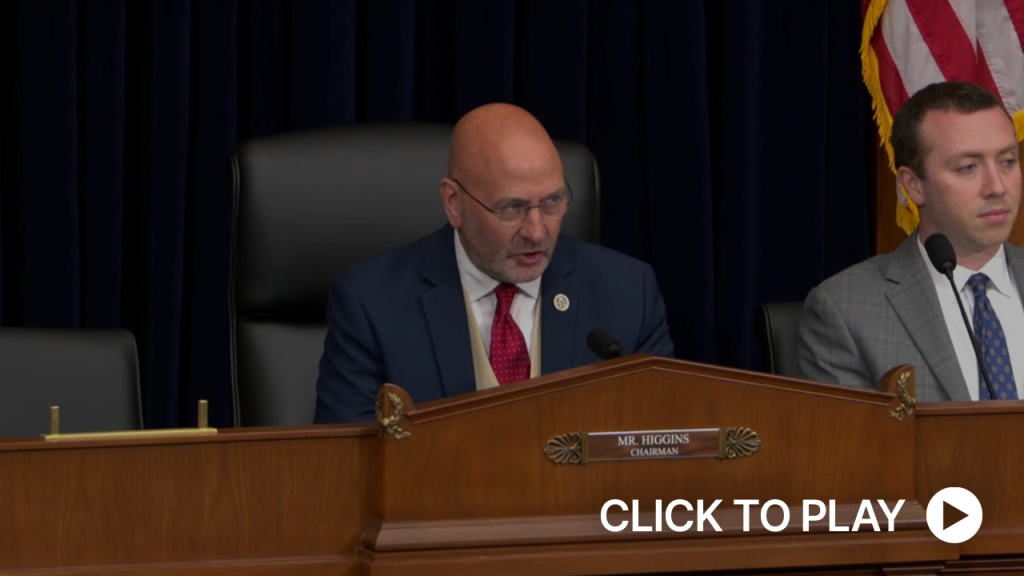
Below are Subcommittee Chairman Higgins’s remarks as prepared for delivery:
Today, the Subcommittee convenes for the third time to confront the crisis of unaccompanied alien children—or UACs—who were left lost, unprotected, and vulnerable to exploitation by the reckless immigration policies of the Biden Administration.
Last July, in our first hearing on this issue, we examined a bombshell report from the DHS Office of Inspector General exposing the Biden Administration’s failure to track hundreds of thousands of these children once they left federal custody.
This past June, we returned to find the damage ran deeper than even the DHS OIG had exposed.
An audit by HHS—released after the DHS report—revealed that during the Biden Administration, the HHS Office of Refugee Resettlement conducted its required monitoring of UAC care facilities in Texas and Florida only 69 percent of the time.
That same audit found that facility staff were routinely onboarded without background checks – opening the door to predators and traffickers alike.
Today, the Subcommittee widens its lens.
Our first two hearings examined the UAC crisis—a humanitarian catastrophe—and the bureaucratic failures that enabled it.
Today we turn to the engine that has powered this crisis from the start: the cartels who built a multi-billion-dollar business around trafficking children, and the financial networks that keep their profits moving.
The scale of this enterprise is staggering.
In 2021 alone, early in the Biden Administration, cartels made as much as $13 billion in revenue from smuggling people into the United States from Mexico.
This trend continued through Biden’s presidency. By January 2024, cartels were earning $32 million per week trafficking migrants across just a single stretch of the Texas border.
Unaccompanied children proved an especially profitable application of the cartel business model. Because these children cannot pay smuggling fees themselves, cartels often collect payment from family members or sponsors to secure their passage.
That arrangement creates a debt that cartels all too often leverage to force children into forced labor or sexual exploitation once the child reaches the United States.
To be clear, this is not merely a human trafficking crisis.
The same transnational criminal organizations profiting from child trafficking are responsible for trafficking the fentanyl that killed over 76,000 Americans in 2023 alone.
This convergence of drug trafficking, human trafficking, and violence led President Trump to direct the designation of a number of cartels as Foreign Terrorist Organizations – arming federal prosecutors with tools to combat trafficking that were unavailable under the Biden Administration.
Further complicating this picture is the rise of Chinese money-laundering networks, or C-M-L-Ns, which have become a critical enabler of cartel trafficking operations.
In August 2025, the Treasury Department’s Financial Crimes Enforcement Network, or FinCEN, issued an advisory warning that these networks help cartels launder proceeds from fentanyl trafficking and human trafficking, causing significant harm to American communities.
FinCEN’s analysis of bank reporting between 2020 and 2024 identified more than 137,000 suspicious activity reports tied to CMLN activity, totaling approximately $312 billion in suspicious transactions.
Unfortunately, our federal law enforcement agencies have been hampered by serious information-sharing obstacles that prevent effective combatting of this illicit financing.
The Government Accountability Office has repeatedly found that Treasury and DHS fail to adequately share financial intelligence relevant to money-laundering investigations.
GAO has also found that agencies across the federal government remain unaware of one another’s anti-trafficking responsibilities.
If we are serious about dismantling cartels’ financial infrastructure, we must close these gaps.
The Trump Administration has already taken important steps to close them.
Beyond the Foreign Terrorist Organization designations, the One Big Beautiful Bill secured more than $108 million to hire additional child exploitation investigators and analysts at Homeland Security Investigations.
Meanwhile, the Department of Justice has been leading a whole-of-government effort to safeguard UACs in the U.S. and bring their traffickers to justice, resulting in a number of high-profile indictments.
These are welcome developments. But more work can be done.
Congress must ensure our federal agencies have the statutory authorities, resources, and interagency structures necessary to follow illicit money as aggressively as we pursue the traffickers themselves.
We have assembled an expert panel today to learn about this crisis from the ground level.
I look forward to today’s discussion.