In Case You Missed It: Congress Is Set to Take on the Middlemen Driving Up Your Prescription Drug Costs
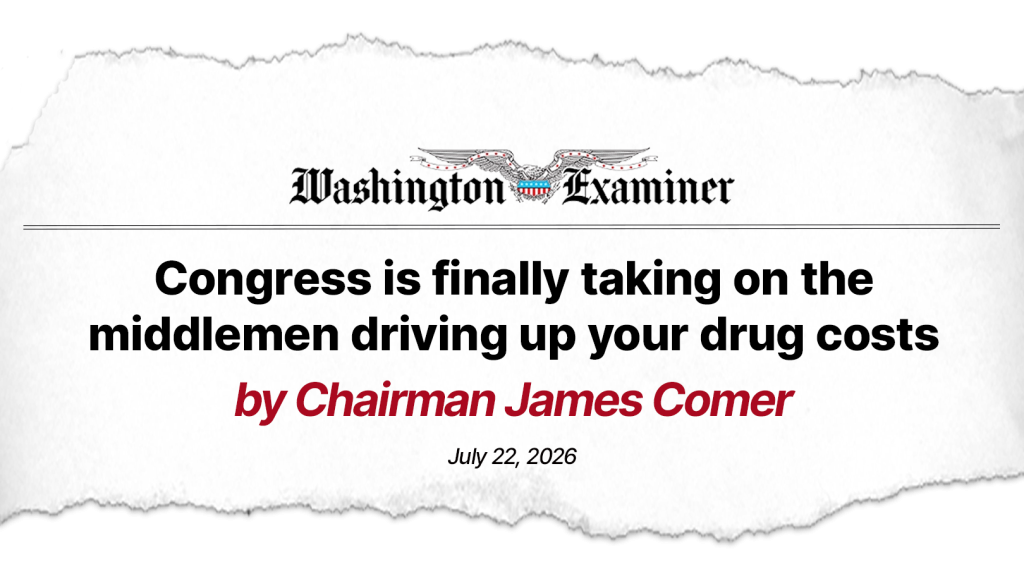
WASHINGTON—House Committee on Oversight and Government Reform Chairman James Comer (R-Ky.) penned a new op-ed in the Washington Examiner in support of the bipartisan Pharmacists Fight Back Act (H.R. 6610), which will hold pharmacy benefit managers (PBMs) accountable for raising prescription drug prices to unaffordable levels for many Americans. This legislation will be considered at the Oversight Committee’s markup today.
In the op-ed, Chairman Comer highlights how three PBMs control 80 percent of the prescription drug market and use rigged reimbursement schemes that force community pharmacies to provide medications at a loss. He details how the Pharmacists Fight Back Act will lower prescription drug prices for Americans and protect patients’ freedom to choose their own pharmacies.
Every day, Americans walk into their local pharmacy and face a price they can’t afford for a drug they can’t live without.
Families are being forced to choose between paying for life-saving prescriptions and covering basic necessities. At the same time, the community pharmacists who provide these critical medications are struggling to keep their doors open.
You deserve to know why this is happening and who is benefiting from it.
The answer: we are paying the price for PBM greed.
Since 2021, the House Committee on Oversight and Government Reform has investigated pharmacy benefit managers, commonly known as PBMs. PBMs operate as middlemen in the prescription drug market, negotiating with drug manufacturers, health insurers, local pharmacies, and federal health programs.
PBMs claim they lower prescription drug costs. But the evidence tells a much different story.
Our investigation, which included more than 140,000 documents and communications, exposed how PBMs use their position as middlemen to benefit themselves at the expense of patients and community pharmacists.
The three largest PBMs now control 80 percent of the market. PBMs retain rebates and fees that should be used to lower costs. PBMs steer patients away from independent pharmacies and toward pharmacies they own. PBMs use rigged reimbursement schemes that force community pharmacies to provide medications at a loss. PBMs even favor more expensive medications when cheaper and equally effective drugs are available.
I have met with pharmacists throughout Kentucky who are pillars of their communities. They know their patients by name, answer questions about medications, and often serve as one of the most accessible health care providers in rural areas. Yet many are being squeezed out of business by predatory PBM practices.
It’s clear this system is not working for the American people. But it is working for the powerful PBMs who profit from it.
Congress has talked about these problems for long enough. It’s time to take on the middlemen.
That is why I joined Representatives Jake Auchincloss of Massachusetts and Diana Harshbarger of Tennessee to introduce the bipartisan Pharmacists Fight Back Act. Today, the Oversight Committee will take an important step toward holding PBMs accountable by passing this legislation.
The Pharmacists Fight Back Act replaces rigged PBM payment schemes with a transparent system based on the actual cost of medications, plus a fair fee for pharmacists who dispense them. This prevents PBMs from manipulating prices and forcing independent pharmacies to fill prescriptions at a loss.
The legislation also protects patients’ freedom to choose where they fill their prescriptions. PBMs should not be allowed to restrict pharmacy networks or steer Americans toward pharmacies they own simply to line their own pockets.
Finally, the legislation strengthens oversight and imposes serious penalties on PBMs that break the law. Transparency without enforcement is meaningless. This bill has the teeth needed to hold bad actors accountable.
These reforms will ultimately help lower patients’ out-of-pocket prescription drug costs, protect access to life-saving medications, support community pharmacies, and safeguard your taxpayer dollars.
This is not a Republican or Democrat issue. Americans across the country are paying too much for prescription drugs. The Pharmacists Fight Back Act has bipartisan support because putting patients ahead of powerful PBMs is common sense.
As Chairman of the Oversight Committee, I made it a priority to expose the PBM industry’s harmful practices. We followed the facts, brought PBM executives before Congress, and showed the American people how these middlemen have contributed to higher costs, fewer choices, and worse care.
Now we are turning those findings into action. This legislation will soon be one step closer to the President’s desk.
The PBM industry is on notice: its era of taking advantage of patients, taxpayers, and community pharmacists is coming to an end.