Grothman Opens Hearing on Technology Lowering the Cost of Healthcare
WASHINGTON—Subcommittee on Health Care and Financial Services Chairman Glenn Grothman (R-Wis.) delivered opening remarks at today’s joint subcommittee hearing on “Lowering the Cost of Healthcare: Technology’s Role in Driving Affordability.” In his remarks, Subcommittee Chairman Grothman sounded the alarm on the trillions of dollars the U.S. spends on health care without meaningful improvements in patient health and stressed the importance of innovative technology in improving these gaps.
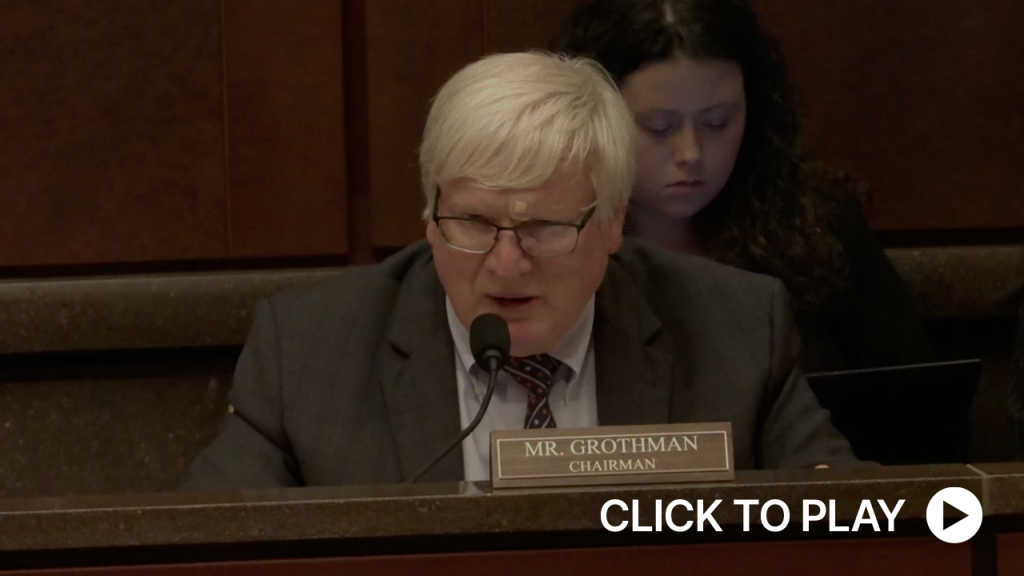
Below are Subcommittee Chairman Grothman’s remarks as prepared for delivery:
Welcome to this joint hearing of the Subcommittee on Economic Growth, Energy Policy, and Regulatory Affairs, and the Subcommittee on Health Care and Financial Services.
This is an exciting opportunity for us to address one of the most pressing issues for Americans: the continuing rising costs of health care.
Health care costs have been steadily increasing for Americans since 1970. Total health care spending in the United States was $4.9 trillion in 2023. That comes out to $14,570 per person. That is almost 18% of the annual Gross Domestic Product. In 1970, health care spending accounted for only 7% of annual GDP. That is an increase of over 150% since 1970.
The United States spends twice as much per person on health care as other peer nations.
It makes sense that overall health care costs have increased in the past 50 years in this country. Our country’s population has grown from just over 200 million people in 1970 to nearly 350 million people in 2025.
The problem is not that we’re spending money on health care. The problem is that the money that we’re spending is being wasted and does not improve patient health.
Recent studies show that nearly 1/3 of health care spending in the United States is wasteful because it does not lead to better patient health outcomes.
In 2023, that would mean that over $1.6 trillion spent on healthcare that year was wasteful.
To put that $1.6 trillion in perspective, the federal government spent that same amount on total health insurance in 2024, including Medicare, Medicaid, Children’s Health Insurance Program (CHIP), and on Affordable Care Act (ACA) marketplace subsidies.
More than half of this wasteful spending can be directly attributed to administrative expenses.
Over the past several decades, the growth in administrative staff has far outpaced the growth in doctors and nurses. Hospitals, insurance companies, and health systems now employ layers of administrators focused on billing, compliance, reporting, coding, and navigating complex regulations rather than delivering care.
In many hospitals today, there are multiple administrative employees for every practicing physician. These costs are passed directly to patients through higher prices, higher premiums, and reduced access to care.
At the same time, patients are often left completely in the dark about prices. Someone scheduling a routine procedure frequently has no idea what it will cost or how prices compare across hospitals, clinics, or providers.
In almost no other sector of our economy do consumers face this level of price opacity.
Just imagine how much more efficient our entire health system would be if more dollars were directed toward patient care rather than bureaucracy.
This is where technology has the potential to make a real difference.
Innovative technology in the health care sector has tremendous capability to reduce administrative burdens through automation, streamline billing and paperwork, and allow patients to compare prices for procedures and treatments across providers.
Empowering patients with price transparency can drive competition, lower costs, and improve access to affordable care.
Today’s expert panel of witnesses will provide their perspective on how the current health care system costs too much, the leading causes of these rising costs, and how innovative technology in the health care sector will make health care more affordable.
We look forward to their testimony today.