Hearing Wrap Up: DEI Erodes Integrity of Law Schools and the Legal Profession
WASHINGTON—Yesterday, the Task Force on Defending Constitutional Rights and Exposing Institutional Abuses held a hearing titled “The Future of DEI in Law School Accreditation and the Legal Profession.” During the hearing, members analyzed how the American Bar Association (ABA) has weaponized its accreditation authority to promote DEI policies that are contrary to federal civil rights law and the negative consequences in the legal profession that result from these harmful policies.Members also heard from witnesses the need for Congress to act to ensure permanent elimination of DEI policies within American institutions, including the legal profession and academy.
Key Takeaways:
The ABA has weaponized its accreditation authority to promote DEI policies that are contrary to federal civil rights law.
- Michelle Behnke, President of the American Bar Association, defended DEI policies, noting that “[The numbers] tell us there’s still more work to do. The data shows that women, lawyers of color, and other groups remain drastically underrepresented in the American legal community. Barriers still remain.”
- Zack Smith, Senior Legal Fellow at The Heritage Foundation, testified that “For example, the ABA has weighed in on hot button cultural issues by supporting nationwide abortion and racial discrimination at American universities. It has opposed Second Amendment rights and has attacked states that refuse to let children cut off their genitals if they feel they were born in the wrong body. Even more egregiously, for an organization supposedly dedicated to the rule of law, it has taken the absurd and patently incorrect position that our Constitution has 28 instead of 27 Amendments. This position that the Equal Rights Amendment has become part of our Constitution is so egregious that even the Biden-appointed archivist of the United States, the official that certifies newly enacted constitutional amendments, rejected it out of hand.”
- David Blackman, former law student at Penn State Dickinson Law, testified that “The ABA leverages its monopoly over accreditation as a weapon. If a university does not bend to these diversity standards, they risk their accreditation and their students risk the ability to sit for the Bar Exam. The ABA is acting as a cartel, enforcing an ideological tax on every future lawyer and every university that accepts federal funds. The American Bar Association has much to answer for, and it’s high time that this monopoly be held accountable for the implosion of blind justice it has caused. They know they are in legal peril. They have quietly tried to backtrack on these radical standards since the supreme court struck down race-based admissions. But make no mistake, even though they scrubbed the language, the activist programs they created remain.”
The ABA’s promotion of harmful DEI policies in law schools and in the legal profession create harmful consequences.
- Mr. Smith also testified that “…Model Rule 8.4 G, DEI challenges and ethical lawyering—Now, for those unfamiliar with the ABA’s Model Rule 8.4 G, it’s a chilling speech code put forward by the ABA under the guise of policing the professionalism of lawyers, but it has drawn condemnation from across the political spectrum, and one Pennsylvania federal court found that Pennsylvania’s version of this professional conduct rule, which was based on the ABA’s model, was unconstitutional…Even setting aside that overlap, the [Law School Accreditation Council] itself has taken a number of controversial actions, including targeting law schools such as George Mason or Saint Thomas for not implementing its radical DEI and other progressive policies aggressively enough.”
- Mr. Blackman also testified that “But in our law schools, this framework has been replaced by a political litmus test. The American Bar Association has done more damage to the neutral administration of our laws than any other institution in modern America. The impact of Standards 206 and 303(c) will be felt for a generation. This is without a doubt the biggest implementation of mandatory DEI in higher education across our nation, touching the lives of every law student who chooses to walk the path of Abraham Lincoln and Thurgood Marshall.”
Proposed changes to eliminate the ABA’s rules on DEI in the accreditation framework may be implemented only begrudgingly, if at all, with the intent to bring them back when the Trump Administration concludes.
- Mr. Smith further testified that “Now that it’s facing an existential crisis and the loss of its monopoly on law school accreditation, the council seeks to back away some from some of its most egregious positions. Consider, as we heard, that it now seeks to repeal Accreditation Standard 206, which requires law schools to demonstrate by concrete action a commitment to diversity and inclusion, which it interpreted as requiring law schools to treat students, faculty and staff differently based on their race…So what’s to be done? First, Congress and the executive branch should build on the good work that has been done and eliminate the ABA as the sole law school accreditor.”
- ABA President Michelle Behnke has previously stated that even as DEI accreditation standards are rolled back, the ABA will not abandon its commitment to DEI policies under “ABA Goal III”.
Member Highlights:
Task Force Chairman Brandon Gill (R-Texas) noted that the ABA’s mission statement claims the legal profession improves when judges reflect America’s diversity. He questioned Ms. Behnke about transgender representation on the Supreme Court and she repeatedly refused to answer the question.
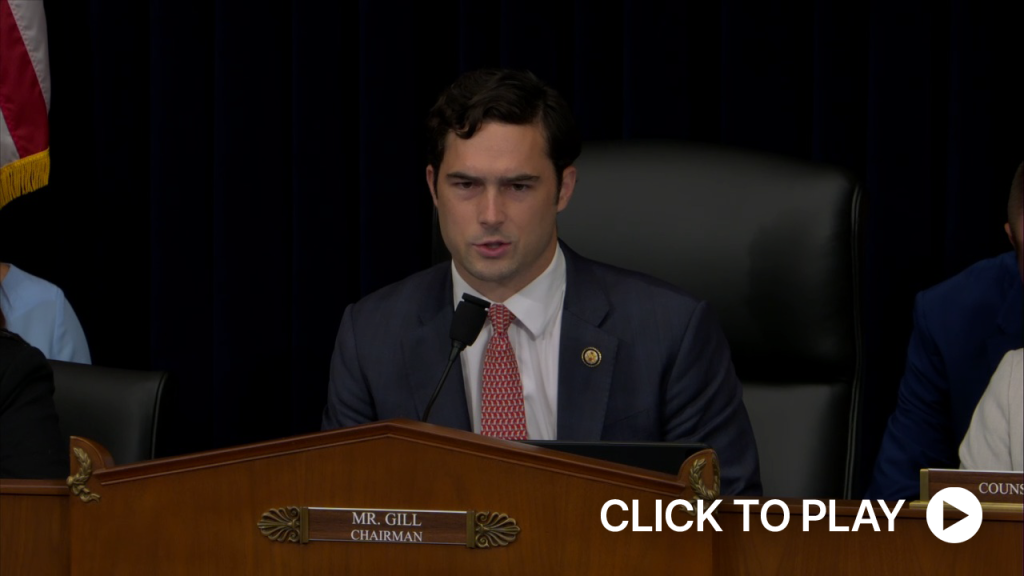
Task Force Chairman Gill: “So transgenders haven’t been represented on the Supreme Court. Do you think that it’s important that the next Supreme Court Justice be transgender?”
Ms. Behnke: “The ABA does not subscribe to any particular quotas.”
Task Force Chairman Gill: “I’m not asking about a quota. I’m asking about representation, equity and inclusion.”
Ms. Behnke: “The ABA supports diversity in all of its forms and supports the full spectrum of…”
Task Force Chairman Gill: “Do you think that it’s a problem that the transgender community has never had representation on the U.S. Supreme Court?”
Ms. Behnke: “The ABA believes in diversity, equity and inclusion, and—”
Task Force Chairman Gill: “I’m asking you about diversity, equity and inclusion. I’m asking you about inclusion of the transgender community.”
[…]
The ABA has repeatedly and long supported the proposition that race should be considered as a factor in law school admissions. Rep. Gill questioned Ms. Behnke about race-based admissions and she again deflected.
Task Force Chairman Gill: “Okay, we’re going to move on. Should Americans be judged by the color of their skin or the content of their character?”
Ms. Behnke: “Discrimination is never appropriate, sir.”
Task Force Chairman Gill: “So, do you agree that Americans should be judged by the content of their character and not by the color of their skin?”
Ms. Behnke: “Yes, I would agree.”
Task Force Chairman Gill: “You agree with that? Should a law school consider an applicant’s race when making admissions decisions?”
Ms. Behnke: “The Supreme Court has indicated that—”
Task Force Chairman Gill: “I’m asking you if they should. It’s a normative question.”
Ms. Behnke: “Discrimination is never appropriate.”
Task Force Chairman Gill: “So is it your testimony that law schools should not consider applicants race when making admissions decisions?”
Ms. Behnke: “The Supreme Court has said that you may not take race into account.”
Task Force Chairman Gill: “So you don’t believe that race should have any role, yes or no, in a law school’s admissions decisions? What is the position of the ABA?”
Ms. Behnke: “The ABA is not responsible for admissions.”
Task Force Chairman Gill: “I didn’t say it was. I’m asking you if you if you believe and if it’s the position of the ABA, that race should not be a factor at all in a law school’s admissions decisions.”
Ms. Behnke: “The ABA takes compliance with the law, seriously.”
Task Force Chairman Gill: “I didn’t ask you that. It’s a really simple question. I’m asking you, should it? Let me just ask you, in your own personal capacity, should race be a factor in law school admissions decisions? The question is a yes or no question.”
Ms. Behnke: “I am here in my capacity—”
Task Force Chairman Gill: “Yes or no, should race be a factor in law school admissions decisions?”
Ms. Behnke: “I am here in my capacity—”
Task Force Chairman Gill: “According to the ABA, it should. The ABA has said explicitly that they have a long history of supporting consideration of race in law school admissions. Is that your testimony? That law schools should continue taking into account race?”
Ms. Behnke: “The Supreme Court indicated that diversity is a laudable goal and the ABA supports diversity in all—”
Task Force Chairman Gill: “This is embarrassing for you. You ought to be able to answer this in a very straightforward way.”
Rep. Jim Jordan (R-Ohio) grilled Ms. Behnke on the ABA’s partisan stances on political issues, despite claiming to be a nonpartisan organization.
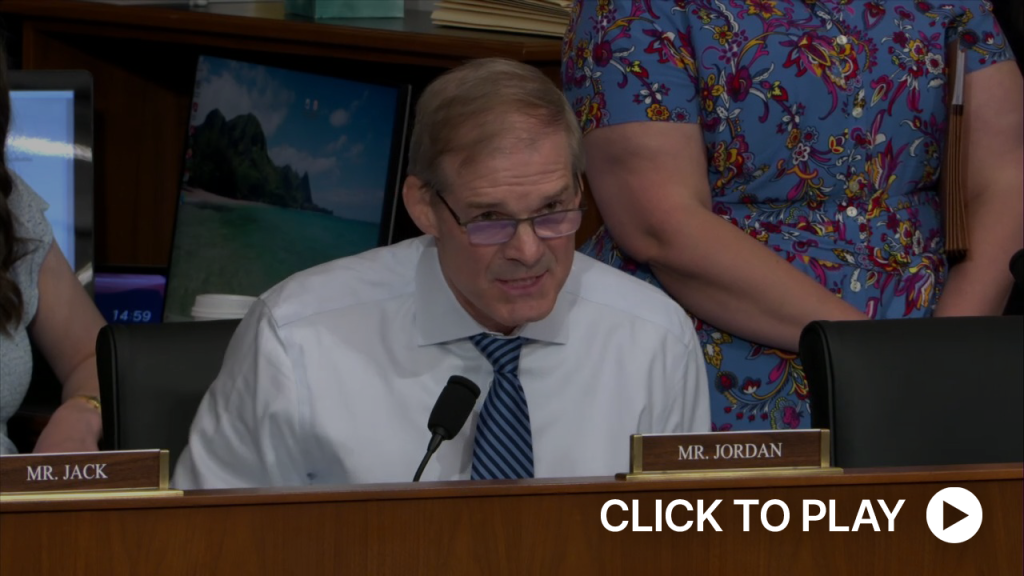
Rep. Jordan: “Third sentence of your written testimony. You said that the American Bar Association is a nonpartisan organization. Is that really true?”
Ms. Behnke: “Yes, sir, it is.”
Rep. Jordan: “Really? Do you take any partisan positions as the American Bar Association?”
Ms. Behnke: “The ABA takes position when our House—”
Rep. Jordan: “The American Bar Association opposes any law that restricts abortion. This this came out after the Dobbs decision. That’s pretty partisan. The American Bar Association opposes detention of individuals who are here illegally, any migrants who break our immigration laws. You oppose detention? Those sound pretty partisan positions to me. Would you agree?”
Ms. Behnke: “The ABA takes positions by our House of Delegates, which is made up of 600 lawyers from across the country. When we take positions, we do so based on the information that we believe is.”
Rep. Jordan: “How about how about men and women sports? Do you have a position on that?”
Ms. Behnke: “I don’t have a list of all our [positions].”
Rep. Jordan: “I’ll read from the American Bar Association, adopted by the House of Delegates, August 9th, 2021 resolution. The American Bar Association opposes any federal, state, local, territorial, tribal regulation, or policy that prohibits transgender students from participating in athletics in accordance with their gender identity. Sounds like you’re for men and women’s sports to me.”
Ms. Behnke: “Our House of Delegates adopted a resolution based on the discussion and debate of our 600-member board.”
Rep. Jordan: “I’ve never heard of a nonpartisan organization that’s for unrestricted abortion, no detention for people who break our immigration law, and who want men and women’s sports. I’ve never heard of a nonpartisan organization adopt those positions. You still say you’re nonpartisan?”
Ms. Behnke: “I do, sir.”
Rep. Jordan: “Wow, that’s amazing…”
Rep. Michael Cloud (R-Texas) inquired about the overlap between the ABA and Law School Accreditation Council and the immense influence it has over law school accreditation.
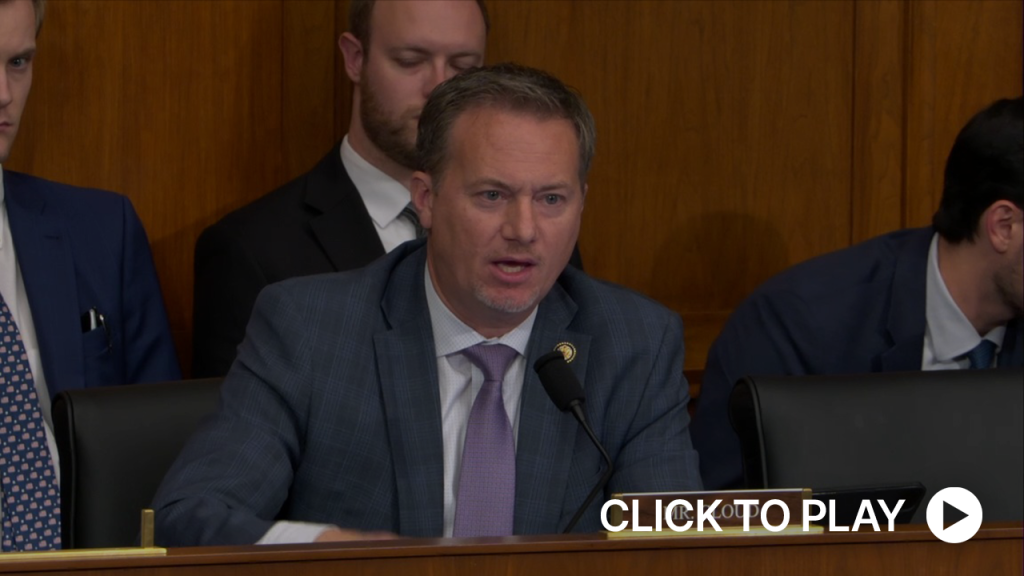
Rep. Cloud: “Mr. Smith, you’ve done some work and study on this. The ABA, in a sense, acts as a gatekeeper. Yes, there’s a little bit of a divide between the Accreditation Council, but, you know, there’s a lot of overlap there as well. And as far as how the members of that council are selected, could you speak to that? And really, should we have one organization kind of being the gatekeeper, or should the [Department of Education] look at multiple institutions, or would it be better left to the states?”
Mr. Smith: “Yeah, thank you for that question, Congressman. The Department of Education absolutely should authorize more law school accreditors than one monopolistic entity. Now, when it comes to the Council of the ABA section of legal education, there is a lot of overlap. The Council would not exist without the ABA. In order to be a member of the Council, you first have to be a member of the ABA, except for a few public members. The officers of the ABA section of legal education and admissions to the Bar automatically are members of the Council, the accrediting entity. And so, as I mentioned in my opening statement, there is a lot of overlap between the ABA and the Council that does the accrediting.”
Rep. Cloud: “So, sitting here and saying, ‘oh, there’s no overlap.’ I can’t speak to that. It’s probably not exactly accurate.”
Mr. Smith: “There is more overlap than I think that statement [suggests].”
Click here to watch the hearing.