Higgins Opens Hearing on Privacy Protections and the Second Amendment
WASHINGTON—Subcommittee on Federal Law Enforcement Chairman Clay Higgins (R-La.) delivered opening remarks at today’s hearing on “Privacy Protections & the Second Amendment: Examining ATF’s Relationship to the Tiahrt Amendment.” In his opening statement, Subcommittee Chairman Higgins highlighted the Bureau of Alcohol, Tobacco, Firearms and Explosives’s (ATF) history of abusing the Tiahrt Amendment and disregarding the Second Amendment under the Biden Administration. He also expressed hope that the Trump Administration would end the Biden ATF’s most destructive regulations.
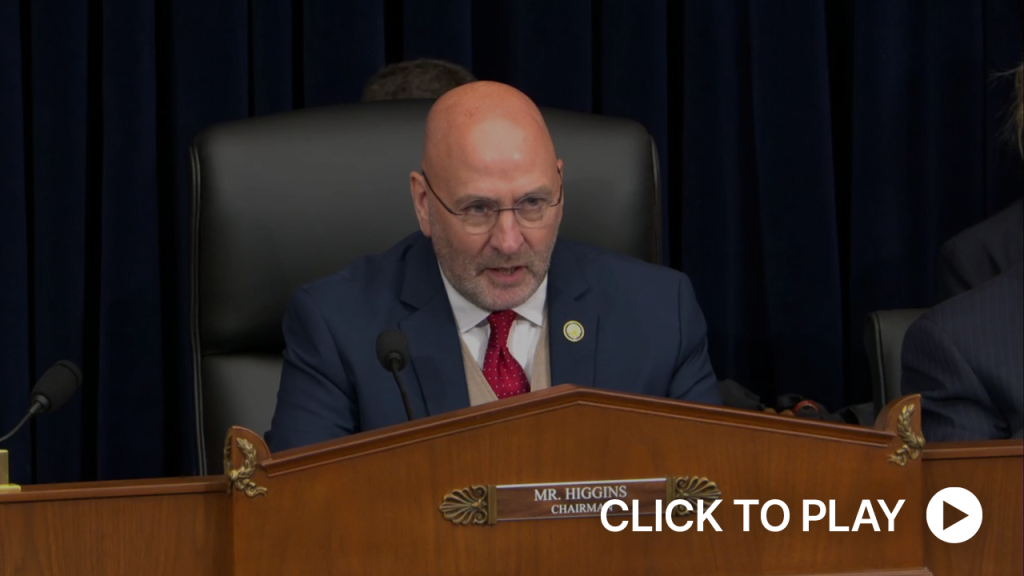
Below are Subcommittee Chairman Higgins’s remarks as prepared for delivery:
Today, the Subcommittee on Federal Law Enforcement convenes to conduct critical oversight of the agency charged with executing our Nation’s firearms laws – the Bureau of Alcohol, Tobacco, Firearms and Explosives, or ATF.
We are honored to be joined by ATF’s newly confirmed Director, Robert Cekada. Director Cekada boasts decades of experience and distinguished service within ATF and law enforcement.
Director Cekada’s deep expertise—and his respect for the law and constitutional rights—should give us optimism about ATF’s future posture toward law abiding gunowners and the Second Amendment generally.
Strong, principled leadership at ATF is all the more important now given the agency’s inexcusable disregard of Second Amendment rights over the past several years.
One acute example has been ATF’s repeated failure to abide by a federal law prohibiting the dissemination of firearms trace data, known popularly as the “Tiahrt Amendment.”
Firearms trace data is information about the chain of gun ownership and sale beginning from the point of manufacture—maintained by the ATF’s National Tracing Center, or “NTC”.
Part of a 2003 Department of Justice appropriations bill, the Tiahrt Amendment precludes ATF from sharing this data with anyone other than prosecutors or law enforcement agencies in connection with criminal investigations.
The purpose of this law is clear. Failure to abide by the Tiahrt Amendment exposes informants, undercover officers, and lawful federal firearms licensees, or FFLs, whose safety would be endangered by the revelations.
Despite Tiahrt’s obvious importance to police and public safety, recent history has shown that ATF has flagrantly disregarded the law. Some violations of Tiahrt have seemed unintentional, associated with accidental data disclosures while responding to FOIA requests.
However, other violations clearly stem from the political and ideological opposition some ATF unelected bureaucrats have for the law.
There are several glaring recent examples, particularly during the Biden Administration. To begin, the Biden ATF assisted gun control groups in creating a map of gun shops, including those owned by Members of Congress, by providing Tiahrt-protected data as part of a FOIA request. ATF’s release of this data was a clear violation of federal law and intended to help anti-Second Amendment groups.
Separately, the Biden ATF inadvertently disseminated Tiahrt-protected data as part of a FOIA request to the group Gun Owners of America, also known as GOA. ATF subsequently secured a gag order to prevent GOA from sharing the data. GOA, supported by several First Amendment groups, sued to retain access to the data by virtue of First Amendment press freedoms.
Dishearteningly, this disregard for the law has not been limited to the Biden Administration. After the Biden ATF’s inadvertent disclosure of Tiahrt-protected trace data to GOA, the DOJ under Pam Bondi re-released that same data—possibly purposely—to make moot GOA’s ongoing litigation against the ATF gag order.
Rather than protecting the public by preventing sensitive firearms trace data from falling into the wrong hands, ATF has defied both the letter and spirit of the law.
ATF’s approach to Tiahrt can serve as a window into the agency’s successes—and failures—upholding the Second Amendment and ensuring protections on sensitive law enforcement data more broadly.
The Biden Administration, in particular, took a variety of troubling actions in this regard. Under President Biden, ATF’s “zero tolerance” enforcement policy—which threatened to close firearm businesses over even small, nonmaterial paperwork and clerical errors—increased reliance on inspection records and compliance data to revoke firearms licenses.
ATF’s 2022 “ghost gun” rule imposed new sweeping recordkeeping and background-check requirements to previously unregulated products, with the purpose of trying to harm the firearms industry and suppress the exercise of the Second Amendment right to keep and bear arms.
Furthermore, Biden-era regulatory changes and enforcement guidance expanded who is considered “engaged in the business” of dealing firearms, potentially implicating unsuspecting everyday Americans as federally regulated gun dealers and subjecting them to severe penalties for noncompliance.
I have faith that the current administration will continue to roll back the Biden ATF’s most destructive regulations. A recently announced batch of ATF proposed rulemakings seek to do just that.
However, ATF’s improper treatment of Tiahrt-protected data demonstrates that rigorous, ongoing congressional oversight of the agency is necessary, regardless of which party controls the White House.
Thank you, Director Cekada, for joining us today to discuss this crucial subject along with other Second Amendment issues. I look forward to today’s hearing.