Burlison Leads Roundtable on Lowering the National Debt by Eliminating Waste, Fraud, and Abuse
WASHINGTON—Subcommittee on Economic Growth, Energy Policy, and Regulatory Affairs Chairman Eric Burlison (R-Mo.) delivered his opening statement at today’s roundtable on “Reducing America’s National Debt: Rooting Out Federal Waste, Fraud and Overregulation.” In his remarks, Subcommittee Chairman Burlison acknowledged that the U.S. national debt is well over $65 trillion and how that harms affordability and Americans’ daily lives. He also highlighted the House Oversight Committee’s dedication to reining in the reckless spending that is increasing the national debt.
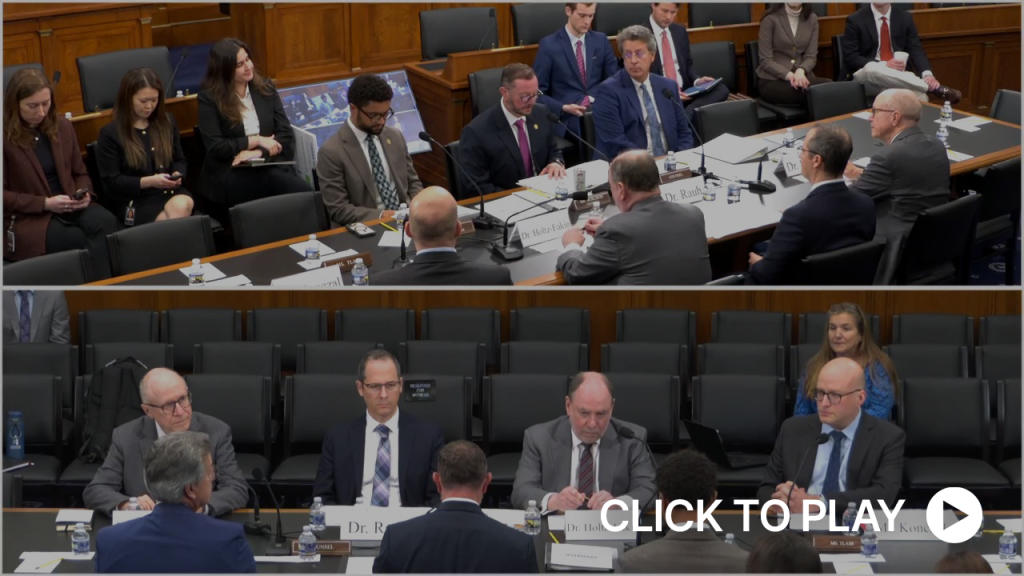
Below are Subcommittee Chairman Burlison’s remarks as prepared for delivery:
Good afternoon.
I welcome everyone to this roundtable on America’s national debt, hosted by the Subcommittee on Economic Growth, Energy Policy, and Regulatory Affairs.
America’s national debt is historically high and rapidly increasing.
Our fiscal trajectory, without a significant course correction, is unsustainable.
The United States currently owes roughly $39 trillion for its explicit obligations, such as U.S. Treasury bonds.
For its implicit obligations, such as payments owed by law to Social Security and Medicare recipients, America owes well over $65 trillion.
We have known for decades that our national debt is too high and presents a danger to the security of future generations.
But alarmingly, rather than change its ways, Washington, D.C. has in recent years shifted federal spending into overdrive.
As a result, the United States’ explicit debt has grown by over 42 percent since the months just before the COVID-19 Pandemic hit, driven by out-of-control deficit spending.
We are now paying more in interest on our national debt than we are spending on national defense.
Experts estimate that in as few as five years interest payments on the debt could be the single largest item in the federal budget.
America’s debt and deficits threaten our economic security, our national security, and the prosperity of future generations.
They place pressure on consumer and business interest rates, the affordability of Americans’ daily lives, and the Nation’s flexibility to spend as much as may be needed to meet military and societal challenges.
If we continue on this unsustainable spending path, our children and grandchildren—our future—will be crushingly burdened with paying for our past spending.
Some may be tempted to say, “We have heard for decades that America’s debt is too high and we have to change our ways before the sky falls.”
“But, the sky hasn’t yet fallen, so what is different now?,” they might ask.
A few key alarm bells now ringing signal today truly is different.
First, what economists call the “convenience yield” of the U.S. Treasury bonds we rely upon to finance federal spending has turned negative.
In layman’s terms, this means the days are gone when Treasury bonds were thought so safe that buyers would snap them up before other countries’ bonds, even if the other countries’ bonds paid higher interest.
As a result, we now have to pay more interest on our bonds, rapidly compounding our already severe debt.
Second, the rise in Treasury-bond interest rates means the benchmark interest rates for mortgage rates, auto loan rates, student loan rates, credit-card purchases, and other borrowing have all gone up.
That is making daily life less affordable for our constituents.
Third, large and rapidly growing debt, especially debt at the levels reached in the post-pandemic era, has been documented to slow economic growth.
That, again, translates into less affordability for our constituents.
Because of the slower U.S. growth rates in the 21st century compared to the 20th, it now takes 56 years for the U.S. standard of living to double — compared to just 26 years in the 20th century.
Finally, history shows that when a great power begins to pay more in interest on its debt than it does on national defense—as the United States has now done—that country is on a fast path to being a great power no more.
For its part, the Oversight and Government Reform Committee is working hard to rein in the reckless spending that has produced our current fiscal condition.
In just the past two months, the Committee has passed twelve bills to drive down waste and fraud in federal spending, which the Government Accountability Office has identified as responsible for hundreds of billions of dollars or more in losses to the American taxpayer.
Today, we have before us a panel of experts on the vitally important topic of America’s national debt and the challenges it presents.
It is my hope that our discussion today can help us identify still more measures Congress can consider and enact to help right our Nation’s fiscal ship.