Chairman Comer: Congress Must Stop Fraud to Protect Taxpayers
WASHINGTON—Today, House Committee on Oversight and Government Reform Chairman James Comer (R-Ky.) delivered remarks before the House Rules Committee in support of H.R. 8464, H.R. 8312, and H.Res. 1335, which require the U.S. Treasury to return payments that are flagged for elevated fraud risk, establish a permanent anti-fraud analytics function to help agency Inspectors General with their fraud work, and underscore the need to stop fraud in the federal government before it starts, respectively. These bills follow the House Oversight Committee’s investigation into extensive fraud across multiple state social welfare programs, notably the State of Minnesota, and the subsequent release of a new staff report titled “The Cost of Doing Nothing: How Tim Walz and Keith Ellison Fueled Minnesota’s Fraud Explosion.”
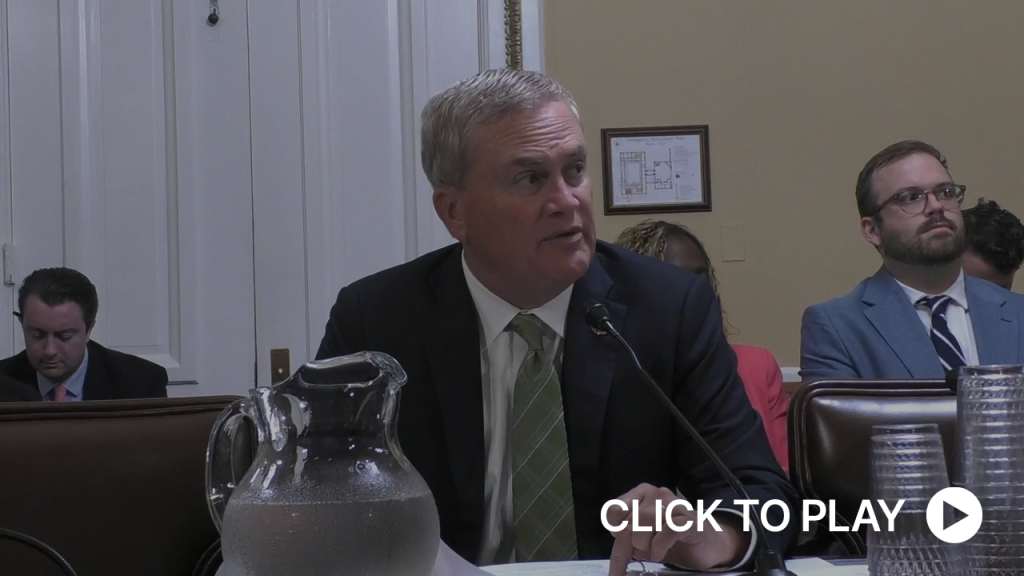
Below are Chairman Comer’s remarks as prepared for delivery:
Thank you Chairwoman Foxx and Ranking Member McGovern.
We are facing a national emergency of fraud in federal programs that is impacting all Americans.
According to the Government Accountability Office, the federal government is estimated to lose between $233 million and $521 billion annually to fraud across all federal programs and operations.
That means the average American tax filer spends between $1,000 and $3,000 annually just on lining the pockets of fraudsters and criminals, while vulnerable Americans are robbed of the benefits these programs were designed to provide.
Investigations conducted by the Oversight Committee into Minnesota’s social services programs uncovered $9 billion that was potentially stolen by fraudsters.
Our investigations exposed how senior state officials— including Governor Tim Walz and Attorney General Keith Ellison—were aware of widespread fraud in federally funded social services programs for years.
These officials possessed the legal and procedural authority to stop fraudulent payments but repeatedly failed to act.
And we see that same lack of care for federal funds in other states as well.
Whether it is widespread fraud in California’s hospice system, or fraud in Medicaid waiver programs for home personal care services in Ohio or New York, it is clear that fraudsters will continue to work to steal taxpayer funds without strong oversight measures in place.
The Trump administration has taken decisive action to combat fraud, waste, and abuse by establishing the White House Task Force to Eliminate Fraud.
Since March, the Task Force has uncovered hundreds of millions of dollars’ worth of fraud just in the State of California, including through suspected fraudulent government contracts, child nutrition programs, and federal student aid applications.
House Resolution 1355, sponsored by Representative Pat Fallon, emphasizes that these schemes across the country harm American taxpayers and the vulnerable recipients who these programs were designed to help.
This resolution underscores the urgent need for stronger fraud prevention reforms to safeguard taxpayer dollars, particularly by preventing fraud before it occurs and thus ending the unsuccessful ‘pay and chase’ model in federally funded programs.
While the Department of Justice’s efforts to hold these fraudsters accountable and recover taxpayer dollars are commendable, taxpayers deserve and demand that we put a stop to fraud before it happens.
That is why we have also brought two bills before the Rules Committee.
The Stopping Fraudulent Payments Act adds critical safeguards to the processing of federal payments to ensure they are made in the right amounts and to the right recipient before an agency awards funds or requests a payment be disbursed.
H.R. 8464 addresses the status quo of ‘pay and chase’ by requiring agencies to conduct fraud prevention and verification activities prior to issuing payment requests.
The bill authorizes the U.S. Treasury to return payments to agencies that are flagged for elevated fraud risks and specific indicators of fraud for further review and corrective action before a payment is issued.
This bill will also help agencies and the American public understand when a legitimate recipient’s identity is being stolen and used for fraudulent activities by criminals.
The Fraud Prevention and Accountability Act dramatically enhances how agencies prevent fraud—especially during any future national emergency.
It also ensures the government-wide data analytic resources established initially to investigate pandemic era fraud are permanently preserved.
Experienced fraudsters understand that when the government responds to a crisis, agencies often let their guard down.
GAO estimates that hundreds of billions of dollars were potentially lost to fraud during the COVID-19 pandemic.
The Pandemic Response Accountability Committee, or the PRAC, built a data analytics capability on the fly as pandemic relief funds were already being expended by agencies.
It is estimated that if the PRAC were established prior to the pandemic, as much as $79 billion dollars in fraudulent payments could have been prevented on the front end.
H.R. 8312 was drafted based on years of diligent oversight work under the leadership of Government Operations Subcommittee Chairman Pete Sessions, the sponsor of this bill.
His legislation ensures there is a permanent, government-wide, anti-fraud analytics function to assist agency Inspectors General with their fraud work.
It ensures a permanent Inspector General Office for Fraud, Accountability and Recovery utilizing the valuable, proven resources built by the PRAC over recent years.
This eliminates the need to start from scratch in the inevitable event of a new national emergency.
I want to emphasize that these bills should be considered in the broader context of the Committee’s legislative work on fraud prevention and financial integrity reforms, the vast majority of which have bipartisan support.
Just today we are also advancing eight bipartisan fraud and program integrity reform bills that will safeguard taxpayer dollars from fraudsters and cheats.
We must continue to advance bold reforms that meaningfully address fraud in these bills and the resolution before you today.
I ask that the Rules Committee grant a prompt Rule for the House’s consideration of this legislation, and I welcome the Committee’s questions.