Comer: Government Must Stop Fraud Before It Starts
WASHINGTON––House Committee on Oversight and Government Reform Chairman James Comer (R-Ky.) delivered remarks on the House floor today in support of his legislation, H.R. 8463, the Pre-Payment Fraud Prevention and Treasury Data Access Act. This follows the House Oversight Committee’s investigation into extensive fraud across multiple state social welfare programs, notably the State of Minnesota, and the subsequent release of a new staff report titled “The Cost of Doing Nothing: How Tim Walz and Keith Ellison Fueled Minnesota’s Fraud Explosion.” In his House floor statement, Chairman Comer underscored how the federal government has lost $2.8 trillion dollars in fraudulent and improper payments since 2003, and how American taxpayers are footing the bill. Chairman Comer highlighted how H.R. 8463 will help prevent fraudulent payments before they occur by enhancing and expanding government financial integrity controls.
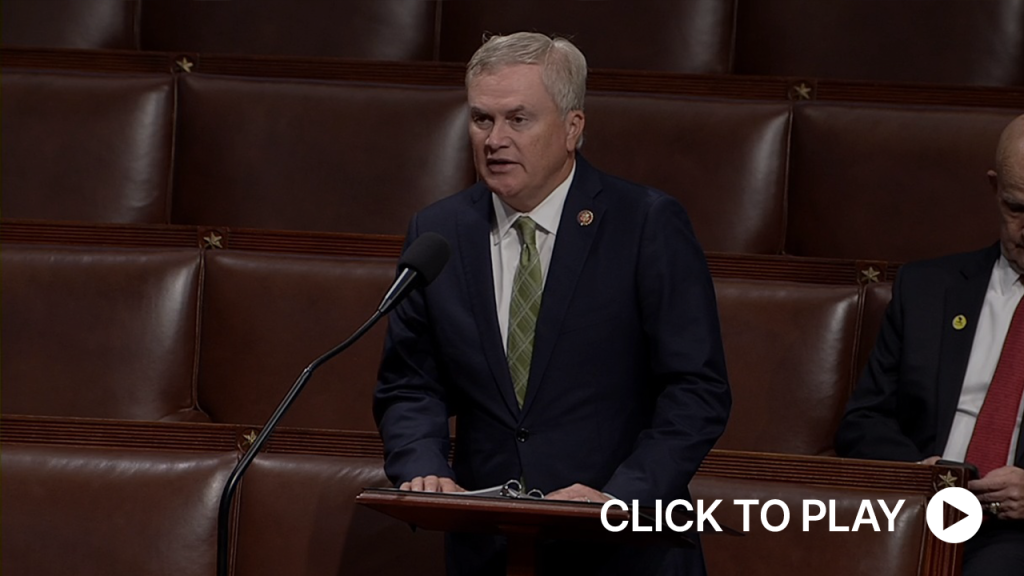
Below are Chairman Comer’s remarks as prepared for delivery:
Thank you, Mr. Speaker.
I rise in support of H.R. 8463, the Pre-Payment Fraud Prevention and Treasury Data Access Act.
Every year, the federal government loses hundreds of billions of dollars to fraud and improper payments.
The Government Accountability Office estimates that the federal government has lost over $2.8 trillion dollars since 2003 to payments that should not have been made or were made incorrectly.
Annual improper payments ballooned to nearly $236 billion in fiscal year 2023, more than six times the amount in 2003.
The Government Accountability Office also estimates that the Federal government loses between $233 billion and $521 billion annually to fraud across federal programs.
Fraud at these levels cost each tax filer on average between $1,000 and $3,000 a year.
These losses should alarm each one of us and call us to action.
The American taxpayer is covering the bill for fraud while criminals get rich.
This bill takes meaningful steps to mitigate this problem by meaningfully curbing fraudulent payments and improper payments before funds go out the door and are lost forever.
The Pre-Payment Fraud Prevention and Treasury Data Access Act enhances and expands government financial integrity controls by requiring anti-fraud risk evaluations to identify suspicious payments before agencies request a payment is issued by the U.S. Treasury.
These reforms are centered around increasing the use and effectiveness of Treasury’s existing Do Not Pay system.
It is currently only utilized by a mere 4 percent of eligible programs across the government.
This bill will address the procedural hurdles agencies face in using the system and bring agencies into compliance with their required anti-fraud checks.
The bill also lowers barriers for Treasury to bring additional non-sensitive datasets into the Do Not Pay system.
This legislation was drafted in coordination with privacy stakeholders to ensure appropriate data protection safeguards for personal and sensitive information.
The reforms in this legislation are commonsense and long overdue.
I want to thank the House Oversight Committee Ranking Member Robert Garcia and his staff for working together with us to ensure such crucial legislation could advance on a bipartisan basis.
I think we have a strong bill that will truly make a meaningful difference for the financial and program integrity of the U.S. government.
I encourage my colleagues to support this bipartisan reform bill.
I reserve the balance of my time.